
Ready to find out more?
Drop us a line today for a free quote!
What is ABS-EC?
ABS-EC (electrically conductive) is a synthetic styrene 3D printing mateiral that can be recycled. It presents the salient feature of offering electrical conductivity and good thermal resistance. ABS-EC is known for its resistance to impact, heat, and aging. Moreover, it provides a good degree of rigidity and robustness. It possesses similar characteristics to ABS-ESD, with the main difference being that ABS-EC has the ability to oppose the flow of an electric current.
What can you use ABS-EC for?
ABS-EC is widely used by all types of industries to construct things such as support beams and brackets, dust-free parts, protective coverings, small electronic components, circuit boards, and touch sensors.
The prints made from conductive filaments can also be effectively used as electromagnetic and radio frequency shields. This can be especially useful in the telecommunications field, and in the maintenance of sensitive measuring equipment such as those found in industrial and scientific laboratories. Sensitive and crucial equipment, such as medical devices and other equipment found in health care institutions, can also benefit from using shields against competing signals which may render them faulty. With conductive filaments, you can make highly customized EMI and RF shields for any number of special applications.

ABS-EC is most widely used for the following applications:
- Small electronic components
- Circuit boards
- Touch sensors (can be used to detect proximity, acceleration, humidity, and fluid levels)
The prints made from conductive filaments (electronic projects) can also be effectively used as electromagnetic and radio frequency shields. This can be especially useful in the telecommunications field, and in the maintenance of sensitive measuring equipment such as those found in industrial and scientific laboratories. Sensitive and crucial equipment, such as medical devices and other equipment found in health care facilities can also benefit from using shields against competing signals which may render them faulty. With conductive filaments, you can make highly customized shields for any number of special applications. 3D printing plays an important part in scaling conductive filaments that would normally take much longer with traditional engineering methods.
ABS-EC Performance Features
- Electrical conductivity
- Good thermal resistance
- Opposes the flow of an electric current (which allows electrons to circulate more rapidly - i.e. metals)
- Provides a good degree of rigidity and robustness
- Resistance to impact, heat, and aging
ABS-EC Material Properties
- Filament properties for ABS-EC include (link to KIMYA):
- Diameter: 1.75-2.85mm
- Density: 1.035g/cm²
- Moisture Rate: <0.5%
- Melt Flow Index: 8-16 g/10min
- Glass Transition Temperature: 108℃
- Tensile Modulus: 2,398 MPa
- Tensile Strength: 36.7 MPa
- Strain at strength: 2.3%
- Stress at break: 29.2 MPa
- Strain at break: 5.2%
- Flexural modulus: 1,393 MPa
- Flexural strain at break: >5%
- Shore hardness: 67.2 Shore D
Disclaimer: The above information is provided in good faith. JuggerBot 3D assumes no obligation or liability for the accuracy or completeness of the information supplied in this document. It is solely the customers responsibility to determine if the product and information in this document are appropriate for the customers end use. Responsibility for the use, storage, handling, and disposal of the products herein is that of the purchaser or end user.
Printer Requirements and Settings for ABS-EC
Printing ABS-EC is recommended to take place in an enclosure sheltered from air currents in a controlled atmosphere of 40°C to ensure a good level of inter-layer adhesion.
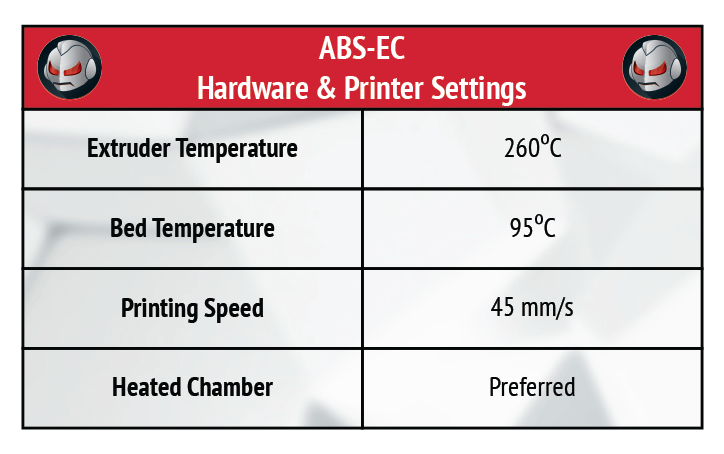

3D Printing with ABS-EC - the procedure
When printing with ABS-EC, a heated plate (80°C) should be used with an extrusion temperature of 260° (as seen in chart above). Printing is recommended to take place in an enclosure sheltered from air currents in a controlled atmosphere of 40°C to ensure a good level of inter-layer adhesion.
Contributor's Bio:
Kimya by ARMOR Group | The main mission at ARMOR is to bring our high-quality filaments to the world market and provide our 3 tiered additive solutions to today’s service and manufacturing challenges. The ARMOR group also specializes in the formulation and coating of high-technology inks onto ultra-thin films. As an international company enjoying rapid growth, ARMOR positions itself exclusively in leading markets. Looking towards the promising future of 3D materials, ARMOR’s industrial expertise has enabled it to recruit, since 2017, the best experts, and to develop Kimya.